Duolingo for Brazilian Portuguese: Is It Enough?
See what Duolingo Portuguese teaches, where it helps beginners, and when to add real Brazilian reading, listening, and conversation practice.
 Samuel Virgo
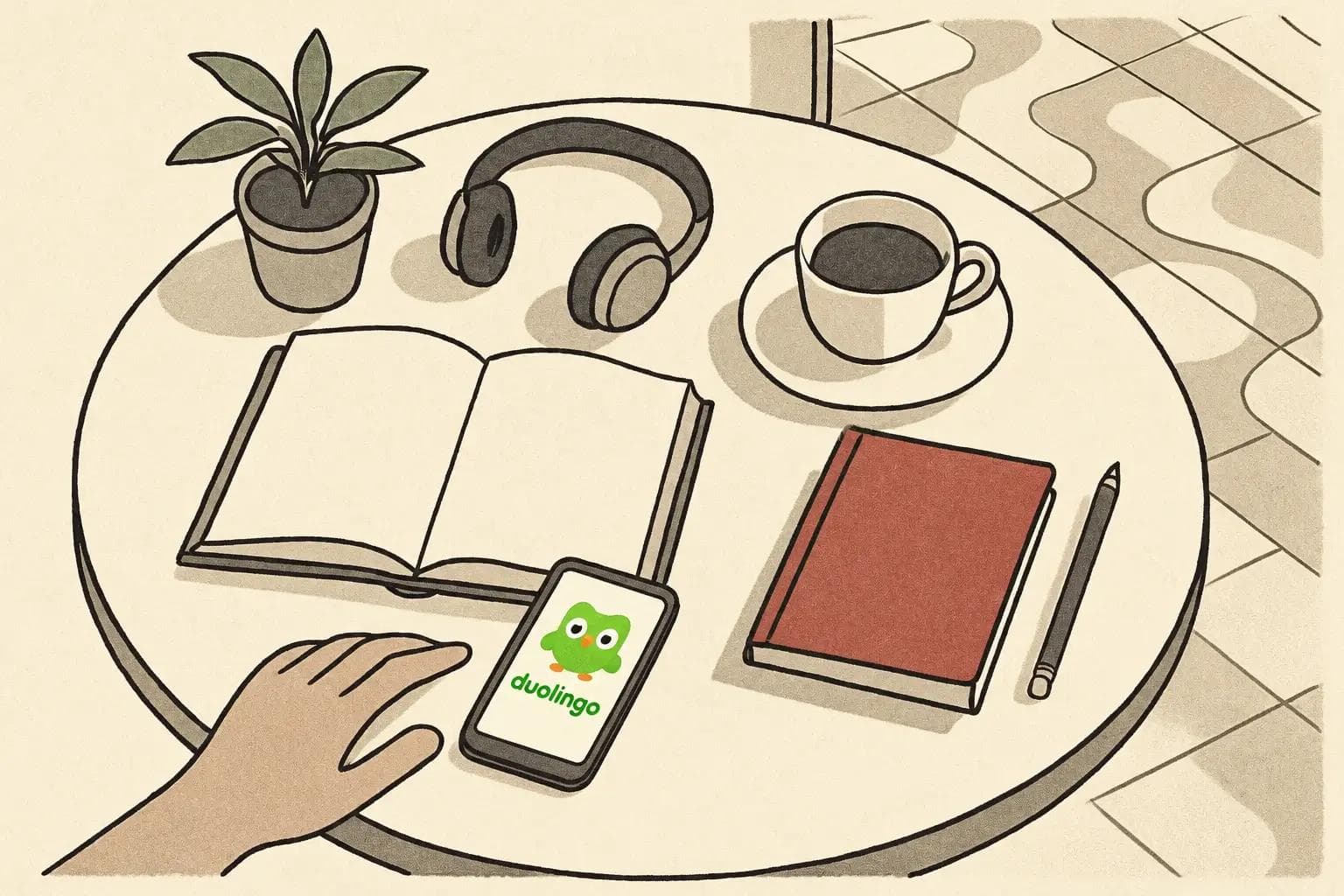
Duolingo can be a good way to start learning Brazilian Portuguese.
It can help you build a daily habit, learn common vocabulary, recognize sentence patterns, and get comfortable with the basics. Duolingo's Portuguese course now includes content through B2, according to Duolingo.
But there is a difference between learning Portuguese inside an app and being able to use Portuguese outside it.
You can have a long streak and still struggle with a Brazilian podcast.
You can complete hundreds of lessons and still find a Brazilian book difficult.
You can recognize a sentence when Duolingo shows it to you and still have no idea what to say when someone asks you the same thing in real life.
That doesn't mean Duolingo is useless. It means that app progress and real Portuguese are different things.
So the better question isn't:
Is Duolingo good or bad?
It's:
How far can Duolingo take you, and what should you add if you want to use real Brazilian Portuguese?
Is Duolingo good for Brazilian Portuguese?
Yes, especially as a beginner tool. But Duolingo works best as one part of your Portuguese routine, not the whole thing.
Duolingo is particularly good at making Portuguese easy to practise every day. Its short, bite-sized lessons, streaks, XP and game-like structure reduce the friction of studying. That matters because consistency is a prerequisite for making progress.
It can help you:
- learn common vocabulary
- recognize basic sentence patterns
- practise grammar in context
- review words at the right moment, through spaced repetition, a technique shown to help second-language learning
- get repeated exposure to Portuguese
- practise short reading and listening activities
- establish a daily learning habit
There is also peer-reviewed evidence that Duolingo can improve reading and listening skills in beginner courses, although that study looked at Spanish and French rather than Brazilian Portuguese. It also did not assess speaking or writing.
So there is no need to pretend Duolingo doesn't work.
It does useful things.
The question is what happens when you leave the app.
Does Duolingo teach Brazilian Portuguese?
Yes. Duolingo's Portuguese course is aimed at Brazilian Portuguese.
If your goal is to learn Portuguese for Brazil, that makes Duolingo a reasonable place to start.
But there is an important distinction between Brazilian Portuguese and all Brazilian Portuguese.
Brazil is enormous, and people don't speak exactly the same way everywhere. Pronunciation, vocabulary, expressions and conversational habits vary between regions and social contexts.
More importantly, Duolingo gives you a controlled version of the language.
That's useful when you're learning.
But eventually you need to hear and read Portuguese as it actually appears in the world: different voices, different accents, informal expressions, longer sentences, incomplete sentences, slang, background noise, and people who aren't carefully constructing a language exercise for you.
That is where the next stage of learning begins.
How far can Duolingo take you in Portuguese?
This is where things get confusing.
Duolingo says that its Portuguese course now contains content through B2, the fourth level of the CEFR framework.
But course content through B2 is not the same thing as proving that every learner who completes the course can perform at B2 in real life.
A course can teach advanced material.
That doesn't automatically mean you can understand a Brazilian speaking naturally, write a complicated message, participate in an unscripted conversation, or read a novel comfortably.
The same distinction applies to Duolingo's own progress measures.
Your Duolingo numbers measure different things
| Duolingo number | What it measures | What it doesn't tell you |
|---|---|---|
| Streak | How many days in a row you've practised | How much Portuguese you can use |
| XP | How much activity you've done in the app | How well that activity transfers outside it |
| Course progress | How much of the course you've covered | Whether you can do those things without the app's support |
| Duolingo Score | Your progress through the course content | Your ability in a real conversation, book or podcast |
All of these can be useful.
None of them, on its own, tells you:
"You can now understand Brazilian Portuguese."
That's because language ability isn't one number.
The CEFR, for example, distinguishes between reading, listening, spoken interaction, spoken production and writing.
And those skills don't necessarily develop at the same speed.
You might be able to read simple Portuguese while understanding very little spoken Portuguese.
You might understand a lot but struggle to produce your own sentences.
You might know the grammar but still need more exposure before Portuguese feels automatic.
So instead of asking:
"What is my Duolingo level?"
it's often more useful to ask:
"What can I actually do in Portuguese?"
Why can I understand Duolingo but not real Portuguese?
This is the most important distinction.
Inside Duolingo, the task is usually carefully constrained.
You might:
- choose an answer
- match words
- translate a sentence
- fill in a missing word
- repeat something you've just heard
- choose from a small number of possibilities
Real Portuguese doesn't give you those advantages.
Someone talks to you and you have to understand them.
A friend sends you a message containing an expression you've never seen.
You open a Brazilian article and encounter three unfamiliar words in the same sentence.
You start reading a book and discover that the meaning of a sentence depends on something that happened two paragraphs earlier.
You hear:
"Você vai lá amanhã?"
And your brain has to deal with the words, pronunciation, context and meaning simultaneously.
That's a different task.
Duolingo practice vs. real Portuguese
| Duolingo often gives you | Real Portuguese asks you to |
|---|---|
| Short sentences | Follow connected speech and longer texts |
| Controlled audio | Understand natural Brazilian speech |
| Multiple-choice or word-bank support | Produce your own answer |
| Immediate feedback | Work out meaning from context |
| Small exercises | Stay with Portuguese for minutes or pages |
| Repeated target vocabulary | Deal with whatever vocabulary actually appears |
| A clear next step | Decide what matters when something is unfamiliar |
This is why you can feel like you're progressing rapidly inside an app while real Portuguese still feels surprisingly difficult.
The app hasn't necessarily failed. You've simply reached a different kind of task.
Is Duolingo enough to become fluent in Brazilian Portuguese?
For most learners, Duolingo alone shouldn't be treated as a complete Portuguese-learning plan.
That doesn't mean you need to stop using it.
It means you need to give yourself opportunities to do things Duolingo cannot fully simulate.
Paul Nation's Four Strands framework is useful here. It separates language learning into four kinds of practice, which a good routine balances:
| Strand | What it means |
|---|---|
| Meaning-focused input | Understanding Portuguese |
| Meaning-focused output | Producing Portuguese |
| Language-focused learning | Deliberately learning vocabulary, grammar and pronunciation |
| Fluency development | Becoming faster and more automatic with what you already know |
Duolingo can contribute to several of these.
But if almost all your Portuguese time consists of short app exercises, you may be giving yourself much less:
- extended reading
- natural listening
- spontaneous speaking
- independent writing
- feedback
- repeated exposure to connected Portuguese
And those are exactly the things you eventually need.
How do you know if Duolingo is actually working?
Don't use your streak as the test.
Test your Portuguese outside the app.
Try these five checks.
| Skill | The check |
|---|---|
| Reading | Can you read a short Brazilian text without a word bank and understand the main idea? |
| Listening | Can you understand the general meaning of simple Brazilian audio without seeing the transcript? |
| Speaking | Can you say a few sentences about yourself without translating a sentence that Duolingo has given you? |
| Interaction | Can you handle a simple exchange when you don't know exactly what the other person is going to say? |
| Writing | Can you write a short message in Portuguese and get useful feedback on it? |
These aren't formal proficiency tests. They're closer to the "can-do" descriptions the CEFR uses: simply a way of asking whether what you're learning transfers outside the app.
If you can do them, great.
If you can't, that's useful information too.
It tells you what kind of practice you need next.
The Duolingo plateau: when app progress stops feeling like Portuguese progress
There isn't a particular number of days, XP points or units where every Duolingo learner suddenly hits a "plateau."
The more useful definition is:
You keep getting better at Duolingo-shaped tasks, but that improvement isn't transferring to the Portuguese you actually want to use.
You might notice that:
- you still need word banks to produce sentences
- Brazilian audio feels impossibly fast
- you avoid books because they contain too many unknown words
- you can recognize a sentence but can't create one yourself
- you keep repeating easy exercises mainly to protect your streak
- you don't know whether your own Portuguese sounds natural
None of this means the time you've spent on Duolingo was wasted.
It means your next practice needs to look more like the Portuguese you want to be able to use.
If you want to speak, speak.
If you want to understand Brazilians, listen to Brazilians.
If you want to read Brazilian books, start reading Brazilian books.
That last one is particularly important.
Because many learners make the same mistake:
They wait until they're ready for real Portuguese before they start using real Portuguese.
But real Portuguese is part of how you become ready.
What should you do after Duolingo Portuguese?
You don't necessarily need to quit Duolingo.
Instead, add the things you're missing.
| If you want to improve... | Add more of... |
|---|---|
| Reading | Brazilian stories, articles and books |
| Listening | Brazilian podcasts, videos and recordings |
| Speaking | Conversations and unscripted speaking |
| Writing | Messages, journaling and writing feedback |
| Grammar | Targeted explanations for things you keep getting wrong |
| Fluency | Repeated reading, listening and speaking with familiar material |
The important thing is to use real Brazilian Portuguese.
Not necessarily difficult Portuguese.
Real Portuguese.
That distinction matters.
A beginner doesn't need to start with a 400-page Brazilian novel and look up every word.
You can start with easier material.
The goal is to move gradually from:
learning about Portuguese
to
using Portuguese.
This is where a reader like Verbeto fits
If you've been learning Portuguese with Duolingo, one of the easiest next steps is reading real Brazilian Portuguese with support.
You don't have to wait until you're "advanced enough" to open a Brazilian book.
You just need a way to deal with the things you don't know without destroying the reading experience.
That's what Verbeto is designed for.
Learn Portuguese by using it
Open a Brazilian book or story.
Start reading.
When you don't know something, tap it.
Verbeto can show you what the word means in the sentence you're actually reading, explain the grammar, and save what you learned so you can come back to it later.
You stay in the book instead of constantly switching between a reader, dictionary, translator and notes app.
You don't become ready for real Portuguese first.
Real Portuguese is how you become ready.
And you can do the same with listening
Reading isn't the only place where the gap between learner Portuguese and real Portuguese appears.
Brazilian speech can be much harder than the carefully controlled audio you're used to hearing in language-learning exercises.
One way to bridge that gap is to listen while following the words.
Verbeto Listen lets you follow a recording line by line as it plays, with the current line highlighted. You can tap words as you encounter them.
That gives you a middle ground between:
"I can understand the app."
and
"Here's a Brazilian podcast. Good luck."
Should you start, continue, reduce or stop Duolingo?
There isn't a universal answer.
| Decision | When it makes sense |
|---|---|
| Start | You're a beginner and need an easy way to build a daily Portuguese habit. |
| Continue | You're enjoying it and your progress is also showing up outside the app: you're recognizing more Portuguese in Brazilian videos, understanding more of a text, or finding it easier to form your own sentences. |
| Reduce | Duolingo is taking most of your study time but you're avoiding the real Portuguese you ultimately want to understand. You don't have to abandon the streak; you can make it one part of a larger routine. |
| Stop | You're opening the app mainly because you don't want to lose the streak, while getting almost no practice with the Portuguese you actually care about. |
The streak isn't the goal.
Portuguese is the goal.
The bottom line
Duolingo can be a useful way to learn Brazilian Portuguese.
It can help you build a habit, learn vocabulary, recognize patterns and get started without much friction.
And its Portuguese course now includes content through B2.
But completing lessons, earning XP or maintaining a long streak doesn't automatically mean you can use Brazilian Portuguese comfortably outside the app.
The real test is what happens when the prompts disappear.
- Can you read?
- Can you listen?
- Can you understand?
- Can you respond?
- Can you keep going when you don't understand every word?
That's the transition that matters.
So don't think of it as Duolingo vs. real Portuguese.
Think of it as:
Duolingo → real Portuguese → more real Portuguese → fluency.
Use Duolingo for what it does well.
Then start using the language itself.
You don't become ready for real Portuguese.
Real Portuguese is how you become ready.
Frequently asked questions
Is Duolingo enough to learn Brazilian Portuguese?
Duolingo can be a useful part of learning Brazilian Portuguese, particularly for beginners, but it shouldn't be assumed to cover every skill you need for independent real-world use. Add real reading, listening, speaking, writing and feedback according to your goals.
Does Duolingo teach Brazilian or European Portuguese?
Duolingo's Portuguese course is aimed at Brazilian Portuguese. If your goal is Portugal, you should use European Portuguese resources alongside it, because the two varieties differ in pronunciation, vocabulary and some grammar.
How far can Duolingo take you in Portuguese?
Duolingo says its Portuguese course includes content through B2. That describes the level of course content available; it shouldn't be interpreted as a guarantee that completing the course makes every learner independently proficient at B2.
Why can I understand Duolingo but not Brazilians?
Duolingo gives you controlled exercises and audio. Real Brazilian Portuguese involves natural speed, different voices and accents, connected speech, context, unfamiliar vocabulary and unpredictable responses. You need exposure to those things to become comfortable with them.
Is Duolingo good for Brazilian Portuguese beginners?
Yes. Its short lessons and habit-building features can make it easier to practise consistently, and it provides useful exposure to vocabulary and sentence patterns. The important thing is to start adding real Portuguese as your skills develop.
If you'd like a more course-like structure, see our Babbel Portuguese review.
What should I use after Duolingo?
Choose material based on what you want to do. If you want to read Brazilian Portuguese, start reading Brazilian stories and books. If listening is your weakness, add Brazilian audio. If speaking is your weakness, add conversation. If you want all of these skills, build a routine that combines them.
To compare Duolingo with a reading-and-listening app, see LingQ vs Duolingo.
Do I need to quit Duolingo?
No. You can keep using it if it is helping. The important question is whether it is supporting your broader Portuguese goal or taking time away from the kinds of Portuguese practice you need next.
Learn Portuguese by using it.
New reading guides, useful Portuguese resources, and notes on learning Brazilian Portuguese — delivered occasionally.
Related articles

LingQ Alternatives for Brazilian Portuguese: Which One Should You Choose?
Compare LingQ alternatives by workflow, price, imports, review, audio, and Brazilian Portuguese fit so you can choose what to test next before paying.
Samuel Virgo13 min read
Readlang Alternatives: Which Reading App Should You Choose?
Compare Readlang alternatives by workflow, from web pages and ebooks to Anki, offline reading, contextual lookup, and Brazilian Portuguese fit.
Samuel Virgo11 min read
LingQ vs Duolingo for Brazilian Portuguese: Which Should You Use?
Compare LingQ vs Duolingo for Brazilian Portuguese and decide whether to use lessons, switch to real input, or combine both without busywork.
Samuel Virgo12 min read