After Duolingo Portuguese: How to Move Into Real Brazilian Portuguese
After Duolingo Portuguese, build a supported routine with real Brazilian reading, listening, and low-pressure speaking so you keep progressing.
 Samuel Virgo
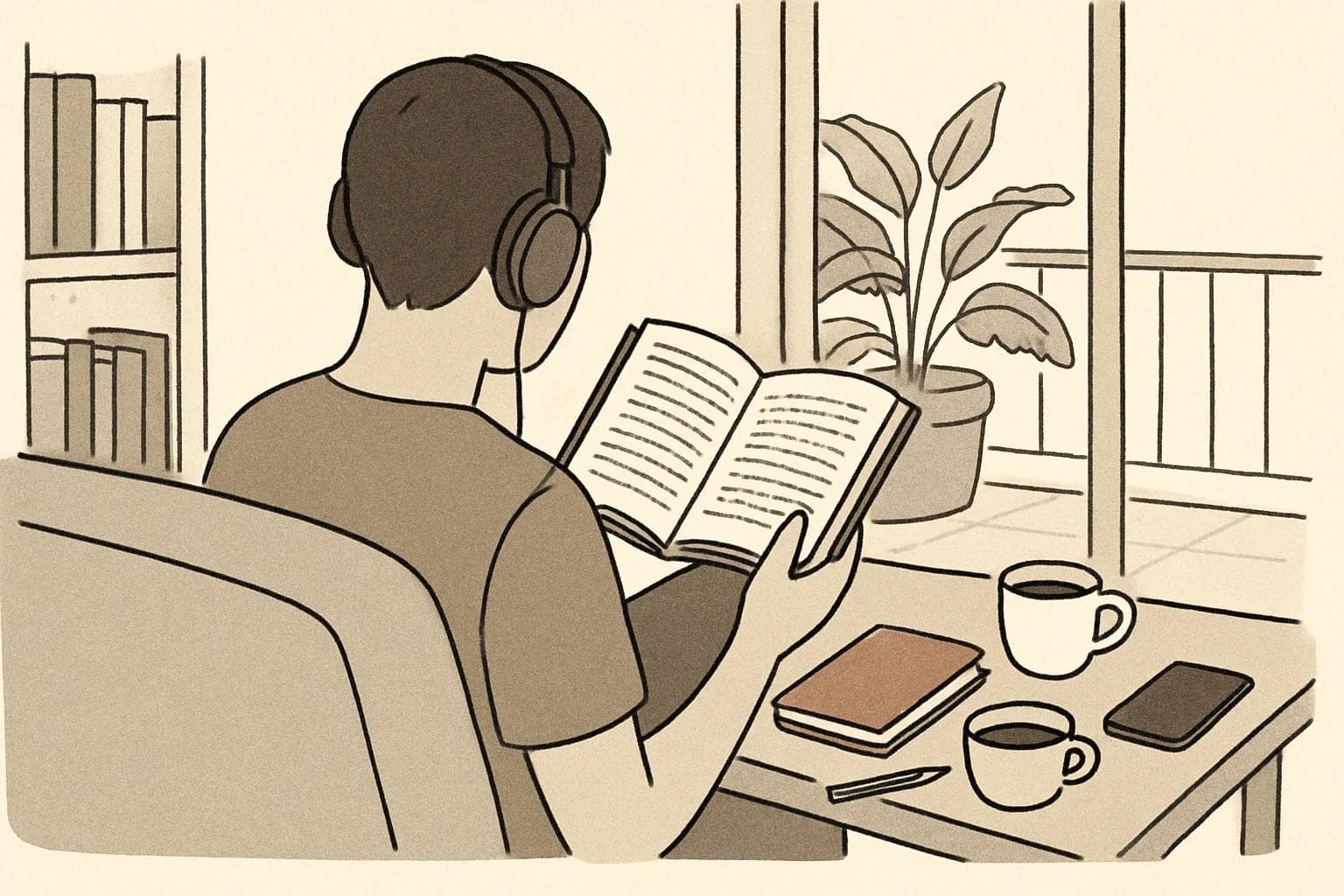
After Duolingo Portuguese, the next challenge is usually not learning more Portuguese inside another app.
It is learning how to use the Portuguese you already know when the prompts disappear.
You may recognize plenty of words and grammar, but still struggle when a Brazilian speaks naturally, when you open a book, or when you have to produce a sentence without a word bank.
That is normal.
The answer isn't necessarily to quit Duolingo or jump straight into two-hour native podcasts and an untranslated Brazilian novel.
The useful middle ground is real Brazilian Portuguese with enough support to keep you going.
The short answer: start using real Portuguese
After Duolingo Portuguese, make real Brazilian Portuguese the center of your routine.
You can keep Duolingo if you enjoy it. Use it for quick review, vocabulary practice, or those days when you only have five minutes.
But stop treating lesson completion, XP or your streak as the main measure of progress.
The next stage should give you more opportunities to:
- Read real Brazilian Portuguese.
- Listen to Brazilian Portuguese as it is actually spoken.
- Speak without being given the answer first.
- Write things you actually want to say.
- Notice vocabulary and grammar in real context.
- Become faster at language you already partly understand.
You don't need to choose between endless app exercises and completely unsupported immersion.
The better path is:
Duolingo → supported real Portuguese → less-supported real Portuguese → more fluent Portuguese
For reading, that might mean using a tool like Verbeto to read Brazilian Portuguese with help available when you need it.
For listening, it might mean starting with audio that has a transcript or captions.
For speaking, it might mean short, prepared conversations rather than immediately trying to hold an hour-long conversation about politics.
The goal is simple:
Stop waiting until you're ready for real Portuguese. Start using real Portuguese to become ready.
If you want a fuller look at what Duolingo does well and where it leaves gaps, see our Duolingo Portuguese review.
What Duolingo Portuguese is good for — and what it does not prepare you for
Duolingo can be a good way to start learning Brazilian Portuguese.
It helps make Portuguese easy to practise regularly. You encounter common vocabulary, sentence patterns, grammar and short listening and reading exercises.
Duolingo says its Portuguese course now includes content through B2. That's useful information about the scope of the course, but it isn't the same thing as saying that completing the course makes every learner independently B2 in real life.
The distinction is important.
Duolingo gives you a controlled task.
Real Portuguese gives you a situation.
| Duolingo can help you with | It does not fully prepare you for |
|---|---|
| Building a consistent study habit | Choosing and sustaining a real reading or listening routine |
| Recognizing common words and sentence patterns | Following long paragraphs, chapters, podcasts or conversations |
| Practising short listening exercises | Understanding natural-speed Brazilian speech |
| Reviewing vocabulary | Meeting unfamiliar words and expressions in context |
| Practising grammar in controlled examples | Working out grammar while following a real conversation |
| Producing sentences with prompts | Deciding what to say from scratch |
| Getting repeated exposure to Portuguese | Dealing with the variety and unpredictability of real Brazilian Portuguese |
None of this makes Duolingo bad.
It means Duolingo and real Portuguese are different environments.
Inside the app, you know what the exercise is asking you to do.
Outside it, nobody tells you which word matters.
A Brazilian friend doesn't give you four possible answers.
A book doesn't highlight the important vocabulary.
A podcast doesn't pause after every sentence.
And a conversation doesn't wait for you to translate what you heard.
That's the next skill you need to build.
Why Portuguese still feels hard after Duolingo
This is probably the most confusing part of the transition.
You can recognize a sentence in Duolingo and still completely lose it when somebody says something similar in real life.
For example:
Não entendi o que você falou.
You may understand that easily when reading it.
But in a real conversation, it might arrive quickly, surrounded by other words, spoken with a particular accent, with no pause to think.
The problem isn't necessarily that you don't know the sentence.
It's that recognizing Portuguese and processing Portuguese in motion are different skills.
A useful comparison is:
| App Portuguese | Real Brazilian Portuguese |
|---|---|
| Short, controlled prompts | Longer conversations and connected texts |
| Known lesson context | Context you have to work out yourself |
| Clear task | No obvious task |
| Selected vocabulary | Whatever vocabulary actually appears |
| Controlled audio | Natural speech |
| Immediate feedback | You have to keep going while uncertain |
| Recognition | Recognition + interpretation + response |
This is why someone can spend months learning Portuguese and then think:
"Why can I understand Duolingo but not Brazilians?"
Because the next challenge isn't simply more knowledge.
It's transfer.
You need to start using what you know in situations that look more like the situations you ultimately care about.
If you want to understand Brazilian books, start reading Brazilian books.
If you want to understand Brazilians speaking, start listening to Brazilians.
If you want to speak, start speaking.
Not necessarily at full difficulty.
But start.
When to stop using Duolingo Portuguese as your main tool
There is no magic lesson, streak or XP number where you have to stop using Duolingo.
Instead, ask whether Duolingo is still giving you the kind of practice you actually need.
It may be time to make it secondary when:
- Lessons mostly feel like review rather than discovery.
- You recognize lots of common words but struggle with them in real context.
- You want to read Brazilian books or articles.
- Brazilian podcasts and videos still feel impossibly fast.
- You want to have conversations rather than complete exercises.
- You can work through a short supported Portuguese text, even if it is difficult.
- You're spending most of your study time protecting a streak rather than using Portuguese.
The important signal is not that you've finished Duolingo.
It's that the app is no longer giving you enough practice doing the thing you actually want to do.
You don't have to delete it.
Change its job.
Use Duolingo for:
- quick review
- maintaining vocabulary
- a low-energy study session
- reinforcing grammar
- keeping yourself in contact with Portuguese
Then spend the rest of your time actually using the language.
If you aren't quite ready to make the switch completely, start small.
Read one short Portuguese passage.
Listen to one minute of audio with a transcript.
Say a few sentences aloud.
The transition doesn't have to be dramatic.
What to study after Duolingo Portuguese: real but understandable input
The best material after Duolingo isn't necessarily the hardest material you can find.
It's material that is real enough to be useful but understandable enough to keep you going.
A useful progression looks like this:
| Material | Why it works | Watch out for |
|---|---|---|
| Graded Brazilian Portuguese stories | Longer context without overwhelming you | Don't stay in graded material forever |
| Supported authentic passages | Real vocabulary and phrasing in manageable amounts | Choose shorter texts if every sentence requires translation |
| Brazilian videos with Portuguese captions | Connects written Portuguese to natural speech | Captions should eventually become less necessary |
| Podcasts with transcripts | Gives you authentic listening with a safety net | Native-speed podcasts can still be too difficult |
| Familiar-topic Brazilian audio | Context makes comprehension easier | Don't make the material harder just for the sake of it |
| Longer unsupported books, podcasts and shows | Eventually this is where you want to go | They may be too difficult as your first step |
The point isn't to avoid authentic Portuguese.
It's to control the difficulty.
A sentence like:
O que aconteceu ontem?
is easy enough to study.
Put those same words inside a fast conversation, surrounded by slang, background noise and unfamiliar vocabulary, and suddenly they are much harder.
That's why graded stories and supported authentic material are useful.
They let you practise something Duolingo can't fully simulate:
staying with meaning over time.
You have to remember who is speaking.
You have to connect one sentence to the next.
You have to infer the meaning of something you don't know.
You have to keep reading even though you aren't 100% certain.
That's much closer to what reading Portuguese actually requires.
The useful rule is:
Understand enough to keep the thread, but not so much that you're only reviewing.
If you understand almost everything, you may need harder material.
If you understand almost nothing, you probably need more support.
The useful zone is somewhere in between.
For more detail, see our guides to learning Portuguese by reading, improving Portuguese reading, and improving Portuguese listening.
Use captions, translations and rereading — then gradually need them less
Support isn't cheating.
If a dictionary, transcript or caption lets you understand something and continue in Portuguese, it's doing its job.
The problem is when the support becomes a replacement for the Portuguese.
For example, imagine you're watching a Brazilian video.
You could:
- Watch it with Portuguese captions.
- Rewatch a difficult section.
- Check a few words.
- Watch it again.
- Eventually try the same section without captions.
That's useful.
Or you could read the entire thing in English first, watch it with English subtitles, and never really have to process the Portuguese.
That's much less useful.
The goal is not:
"I must never use English."
The goal is:
"I want to need English less."
The same applies to reading.
If you click one unknown word, understand the sentence and continue reading, the dictionary has helped you read Portuguese.
If you translate every sentence before trying to understand it, the translation has started doing the reading for you.
A good rule is to fade support according to comprehension.
When something starts becoming easier:
- translate fewer words
- use Portuguese captions instead of English ones
- listen once with the transcript and once without it
- reread a chapter without looking things up
- try a familiar topic with less support
You don't need to prove that you can survive without help.
You need to use help in a way that eventually makes you need less of it.
Make supported Portuguese reading your anchor after Duolingo
Reading is one of the easiest ways to bridge the gap between app Portuguese and real Portuguese.
Why?
Because reading lets you slow real language down without removing context.
Inside Duolingo, you might learn:
- ficar
- querer
- achar
- conseguir
In a story, those same words have to do something.
You need to follow what a character wants.
You need to understand why something happened.
You need to remember what happened two paragraphs ago.
You need to work out an unfamiliar word without stopping the entire exercise.
For example:
Ele ficou em silêncio porque não sabia o que dizer.
You can see ficou in context.
You see how porque connects the two ideas.
You understand a small event rather than completing a vocabulary exercise.
That's a much more useful bridge into real Portuguese.
And you don't need to start with a 400-page novel.
Ten focused minutes with a short Brazilian story can be better than an hour spent fighting through a book where almost every sentence requires a translation.
The important thing is that the Portuguese itself becomes the thing you're practising.
A simple routine is:
- Read a short passage in Portuguese.
- Try to understand the main idea before checking everything.
- Use help where it gets you back into the sentence.
- Reread once with fewer interruptions.
- Save a few useful words or phrases you actually encountered.
Over time, this gives your Duolingo knowledge somewhere to live.
Words stop being isolated answers.
They become part of scenes, arguments, descriptions and conversations.
Grammar stops being something you only recognize in an exercise.
You start recognizing it because you've seen it doing something.
And reading can feed your other skills.
A story you've already read becomes easier to listen to.
A phrase you've encountered becomes easier to use with a tutor.
A chapter you've reread can become a conversation topic.
That's why reading is such a useful anchor for this stage.
How to improve Portuguese listening after Duolingo without drowning in native-speed audio
Listening often feels much harder than reading after Duolingo.
You may look at:
Você entendeu o que ela falou?
and understand it immediately.
Then someone says the same thing naturally and it seems to arrive as one long sound.
That's normal.
Your first goal shouldn't be to understand an hour-long Brazilian podcast with no help.
It should be to connect sound to meaning you already partly know.
A useful listening ramp is:
- Read the meaning first.
Look at the transcript or text before listening. - Listen while following the Portuguese.
Let your eyes help your ears find the words. - Replay short sections.
Notice how familiar words sound when spoken together. - Listen again with less support.
Hide the transcript or only check it when you lose the thread. - Move to similar new material.
Keep the topic, speaker or difficulty reasonably familiar before making everything harder.
Known material is particularly useful.
If you already understand a story on the page, listening to it gives your brain one less problem to solve.
You're no longer asking:
"What does this sentence mean?"
You're asking:
"Why does a sentence I already understand sound so different when a Brazilian says it?"
That's exactly the kind of problem you need to solve.
Useful material includes:
- a story you've already read
- an audiobook chapter you've already studied
- a podcast with a transcript
- a Brazilian YouTube video with Portuguese captions
- a familiar TV scene
- short recordings that you can replay
Be careful with long passive listening if you understand almost nothing.
An hour of Brazilian Portuguese playing in the background may expose you to the sound of the language, but it isn't a substitute for listening you can actually follow.
At this stage, five minutes that you can understand and replay may be more useful than an hour that remains a blur.
For more detail, see our guide to improving Portuguese listening.
How to start speaking Portuguese after Duolingo without pressure
Speaking after Duolingo shouldn't begin as a test of whether you're fluent.
It should begin as repairable communication.
You say something.
It doesn't quite work.
You get help.
You try again.
That's speaking practice.
You can start with something as simple as:
Eu quero praticar, mas preciso falar devagar.
"I want to practise, but I need to speak slowly."
That's useful Portuguese.
It tells the other person what you need.
It creates a real reason to communicate.
And it gives you room to make mistakes.
A low-pressure progression might look like this:
1. Read aloud from something you already understand
Take a short story, dialogue or paragraph you've already read.
You're connecting Portuguese on the page to your mouth and ear.
2. Prepare short answers
Practise answers to questions such as:
- De onde você é?
- Por que você estuda português?
- O que você gosta de fazer?
This gives you something to build on when the conversation starts.
3. Use structured tutor conversations
If you don't have one yet, see our guide to finding a Portuguese tutor.
Pick one small topic: food, travel, books, work, your daily routine.
Ask the tutor to slow down, correct important mistakes and help you reformulate things.
4. Try short exchanges
You don't need a one-hour conversation.
Five or ten minutes on one topic is enough to start.
Learn to use:
Como se diz...?
and
Pode repetir?
and
Pode falar mais devagar?
These aren't signs that your Portuguese is bad.
They're tools that let you keep communicating when it breaks down.
5. Move towards freer conversation
Once short exchanges become manageable, make the topics wider.
Don't jump directly from app exercises to an hour of completely unscripted conversation and use the experience as a verdict on your Portuguese.
The first goal isn't to sound fluent on demand.
It's to build situations where communication can break a little, get repaired and continue.
A weekly Portuguese study routine after Duolingo
A good post-Duolingo routine shouldn't simply recreate Duolingo with a different app.
The point is to spend more of your time using Portuguese.
A simple week might look like this:
| Routine part | What to do | Why |
|---|---|---|
| Supported reading | Read a Brazilian Portuguese story, chapter or passage with help available | Makes real Portuguese the anchor |
| Scaffolded listening | Listen to audio connected to something you've read, using captions or transcripts when useful | Connects sound to meaning |
| Light review | Use Duolingo or another review tool briefly | Keeps useful basics active |
| Low-pressure speaking | Read aloud, prepare answers, send a voice note or have a short guided conversation | Gives you a place to use what you've learned |
You don't need to do all four every day.
If you have 20 minutes:
- 10 minutes reading
- 5 minutes listening
- 3 minutes review
- 2 minutes speaking
is already a better transition than spending the entire 20 minutes protecting a streak.
If you have more time, expand the same activities.
Read longer.
Listen again without the transcript.
Reread something you've already studied.
Take phrases from your reading into a conversation.
The important thing is that your routine repeatedly puts you in contact with understandable Brazilian Portuguese.
It shouldn't be built around protecting a number.
How to measure real Portuguese progress after Duolingo
After Duolingo, your progress should be measured by what you can do with Portuguese, not just what you can complete inside an app.
Ask yourself:
| Skill | A useful sign of progress |
|---|---|
| Reading | You can follow longer passages without translating every sentence |
| Vocabulary | Words from lessons start appearing naturally in new contexts |
| Rereading | The second read feels easier and reveals things you missed |
| Listening | Familiar phrases start separating from the stream of speech |
| Captions | You need less support to follow the same kind of material |
| Speaking | You can handle short exchanges and repair misunderstandings |
| Overall | The same Portuguese requires less help than it used to |
The most useful question is:
Am I needing less help to understand more Portuguese?
That is a much better measure than:
"How many XP did I earn?"
You may still need a dictionary.
You may still need subtitles.
You may still struggle with Brazilian podcasts.
That's fine.
Progress can simply mean that something which previously required five translations now requires one.
Or that a paragraph which felt impossible now makes sense after one reread.
Or that you can understand a sentence when somebody says it rather than only when you see it written down.
Those are real improvements.
And they matter more than finishing another unit.
Common mistakes that keep Portuguese learners stuck after Duolingo
The biggest mistakes after Duolingo tend to go in one of two directions:
staying inside the app forever, or jumping into completely unsupported native material too soon.
| Mistake | What happens | Better alternative |
|---|---|---|
| Staying in review-only mode | You keep improving at app exercises while real Portuguese remains difficult | Keep Duolingo as review and add real Portuguese |
| Jumping straight into very difficult native content | You spend most of the session being lost | Start with shorter or supported material |
| Treating translations as permanent | You always wait for English before understanding Portuguese | Use translation to get back into Portuguese, then fade it |
| Treating captions as cheating | You make listening harder than necessary | Use captions as a bridge, then reduce them |
| Starting with high-pressure conversation | Speaking becomes stressful rather than useful | Use short, structured conversations first |
| Abandoning all structure | "I'll just consume Portuguese" turns into an inconsistent routine | Keep a simple reading/listening/review/speaking structure |
The review-only loop, a common route into the intermediate Portuguese plateau, is particularly tempting because it feels productive.
You can see your streak.
You can see your XP.
You know exactly what to do next.
But if your goal is to understand Brazilian books, conversations and media, eventually you have to practise those things.
The opposite mistake is trying to prove that you're ready by forcing yourself through something far beyond your current level.
A Brazilian novel isn't too advanced forever.
But it may be too unsupported today.
Choose something you can partly understand.
Use help.
Then gradually need less of it.
That's the transition.
The bottom line: after Duolingo, use Portuguese
Duolingo can be useful.
It can help you build a habit, learn vocabulary, recognize sentence patterns and get started with Brazilian Portuguese.
You don't need to pretend it failed just because real Portuguese is still difficult.
But there comes a point where doing more exercises isn't the same as getting closer to the Portuguese you actually want to use.
The next step is not necessarily another course.
It's real Portuguese.
Read it.
Listen to it.
Speak it.
Write it.
Get help when you need it.
Then gradually need less help.
The important transition is:
learning about Portuguese → using Portuguese
If you want to read Brazilian books, don't wait until you're "ready."
Start with something you can understand with support.
If you want to understand Brazilian speech, don't wait until native-speed audio suddenly becomes easy.
Build a bridge into it.
If you want to speak, don't wait until you can construct perfect sentences.
Start with sentences you can repair.
You don't become ready for real Portuguese first.
Real Portuguese is how you become ready.
Frequently asked questions
Is Duolingo enough to learn Brazilian Portuguese?
Duolingo can be a useful part of learning Brazilian Portuguese, particularly for beginners. But if your goal is independent real-world use, you should eventually add real reading, listening, speaking and writing.
Does Duolingo teach Brazilian or European Portuguese?
Duolingo's Portuguese course is aimed at Brazilian Portuguese. If your goal is Portuguese from Portugal, you'll want to use European Portuguese resources alongside it because the varieties differ in pronunciation, vocabulary and some grammar.
How far can Duolingo take you in Portuguese?
Duolingo says its Portuguese course includes content through B2. That describes the level of course content available; it shouldn't be interpreted as a guarantee that completing the course makes every learner independently proficient at B2.
Why can I understand Duolingo but not Brazilians?
Duolingo gives you controlled exercises and relatively controlled audio. Real Brazilian Portuguese involves natural speed, different voices and accents, connected speech, unfamiliar vocabulary, context and unpredictable responses.
You need exposure to those things to become comfortable with them.
Is Duolingo good for Brazilian Portuguese beginners?
Yes. Its short lessons and habit-building features make it easy to practise consistently, and it provides useful exposure to vocabulary and sentence patterns.
The important thing is to start adding real Portuguese as your skills develop.
What should I use after Duolingo?
Choose your next material according to what you want to do.
If you want to read Brazilian Portuguese, start reading Brazilian stories and books.
If listening is your weakness, add Brazilian audio with transcripts or captions.
If speaking is your weakness, add structured conversation.
If you want to develop everything, build a routine around reading, listening, review and speaking.
Do I need to quit Duolingo?
No.
Keep using it if it helps.
The important question is whether Duolingo is supporting your broader Portuguese goal or taking time away from the kinds of Portuguese practice you need next.
The streak isn't the goal.
Portuguese is the goal.
Learn Portuguese by using it.
New reading guides, useful Portuguese resources, and notes on learning Brazilian Portuguese — delivered occasionally.
Related articles
LingQ Alternatives for Brazilian Portuguese: Which One Should You Choose?
Compare LingQ alternatives by workflow, price, imports, review, audio, and Brazilian Portuguese fit so you can choose what to test next before paying.
Samuel Virgo13 min read
Readlang Alternatives: Which Reading App Should You Choose?
Compare Readlang alternatives by workflow, from web pages and ebooks to Anki, offline reading, contextual lookup, and Brazilian Portuguese fit.
Samuel Virgo11 min read
LingQ vs Duolingo for Brazilian Portuguese: Which Should You Use?
Compare LingQ vs Duolingo for Brazilian Portuguese and decide whether to use lessons, switch to real input, or combine both without busywork.
Samuel Virgo12 min read