Readlang Review for Brazilian Portuguese: Is It Worth It?
Readlang review for Brazilian Portuguese learners: see when tap-to-translate, flashcards, imports, mobile use and pricing help or get in the way.
 Samuel Virgo
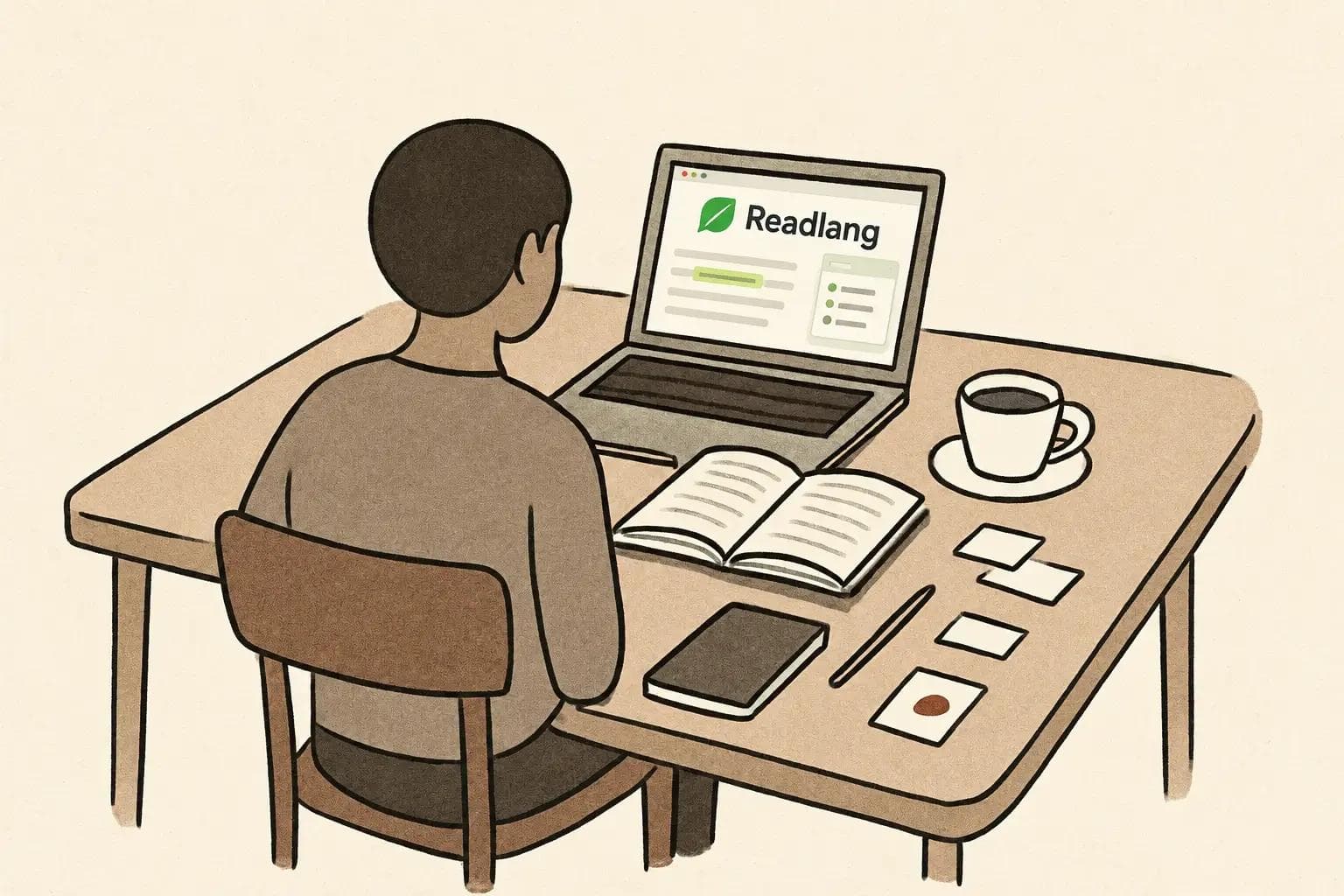
If you're learning Brazilian Portuguese and want to start reading real Portuguese, Readlang is one of the more useful tools to try.
Its basic idea is simple: open something you want to read, click a word or phrase you don't understand, and get help without leaving the text. Words you translate can then be saved for flashcard practice. Readlang also now offers context-aware translations and AI explanations, as well as a web reader, browser tools, audio features and vocabulary management.
But Readlang works best under a particular set of conditions.
If you can already understand most of a Portuguese text, it can make reading much easier.
If the text is far above your level and you're stopping every few words, a translation tool won't solve the underlying problem.
So is Readlang worth it for Brazilian Portuguese?
Yes, particularly if you're ready to read real Portuguese and want quick help with the parts you don't understand.
But it isn't the only way to learn through reading, and the best tool depends on what you're trying to read and how much support you need.
The short answer
| Readlang is good for… | Readlang is less useful when… |
|---|---|
| Reading Portuguese articles and other real texts | Almost every sentence is difficult |
| Quickly checking unfamiliar words and phrases | You need extensive translation rather than occasional help |
| Keeping your reading flow instead of opening a separate dictionary | You want a structured Portuguese course rather than an assisted reader |
| Saving vocabulary from things you've actually read, and turning it into flashcards | Your main goal is speaking rather than reading |
| Learners who already understand a reasonable amount of the text | The material you want to use doesn't work well with your chosen Readlang workflow |
The most important question isn't really whether Readlang is "good."
It's:
Does Readlang make it easier for you to keep reading Portuguese?
If the answer is yes, it is doing its job.
What is Readlang?
Readlang is an assisted reading tool for language learners.
It isn't structured like Duolingo, where you work through lessons and exercises.
Instead, you bring Portuguese into the reading environment and use Readlang when you encounter something you don't understand.
The basic loop is:
Read → get stuck → click → understand → keep reading.
You can click individual words or select phrases for translation. Readlang also saves words you've translated so that you can practise them later with flashcards.
Its current feature set includes an online eReader, Web Reader, flashcards, vocabulary management, dictionary support, video transcription features and AI-powered context explanations.
That makes Readlang fundamentally different from a conventional language course.
You're not primarily learning about Portuguese.
You're using Portuguese and getting help when you need it.
And that's a very good idea.
Does Readlang work for Brazilian Portuguese?
Yes.
Portuguese is one of the languages Readlang supports. Its translations come from Google, whose translation service lists Brazilian Portuguese separately from the Portugal variety, and Readlang has added Brazilian voice options for some of its voice features.
But there's an important distinction:
Portuguese support does not mean that every translation will perfectly explain every piece of Brazilian Portuguese.
That's true of essentially any automated translation system.
Brazilian Portuguese contains:
- Idioms
- Regional expressions
- Slang
- Irregular and inflected verb forms
- Expressions whose meaning depends heavily on context
- Older or literary vocabulary
- Differences between formal and informal language
Consider:
Ela ficou sem graça.
A literal translation of the individual words doesn't tell you what the sentence actually means.
Depending on context, you might translate it as:
She felt embarrassed.
or:
She became awkward/uncomfortable.
The important thing is the meaning of the expression in context.
Readlang has moved beyond its original simple word-translation model. Its Premium plans include context-aware translations and unlimited context explanations, and Readlang says these use AI to take the surrounding sentence into account.
That's a significant improvement.
Still, I would treat any automated explanation as help rather than absolute authority, particularly when you're reading literature, slang-heavy dialogue or unusual vocabulary. Learners have noticed Readlang explaining rarer, older words inconsistently.
If a translation looks strange, check it.
The biggest question: how difficult should your Portuguese text be?
This matters more than almost any feature.
Imagine you open a Brazilian novel.
You understand:
João entrou na sala e olhou pela janela.
You don't know:
Ele ficou meio sem jeito quando percebeu que ela estava olhando para ele.
A quick lookup can solve the problem and let you continue.
That's exactly the kind of situation where an assisted reader is useful.
But imagine that every sentence looks like the second one.
You're constantly clicking words.
Then phrases.
Then grammar.
Then another phrase.
At that point, Readlang hasn't necessarily stopped working.
The text is probably too difficult.
Reading research has consistently found that the amount of vocabulary you already know and the difficulty of the text affect comprehension. Glosses can help vocabulary learning, but they don't magically turn an advanced text into an appropriate beginner text.
Readlang's own design points the same way: it limits how long a translated phrase can be, so learners fill gaps rather than translate whole sentences.
This gives us a useful rule:
A reading tool should help you read a text you can mostly follow. It shouldn't have to translate the entire text for you.
That's why Readlang is likely to be most useful once you have enough Portuguese to follow the general meaning of what you're reading.
Readlang is particularly good at one thing
Reducing the cost of not knowing a word.
Without an assisted reader, you might do this:
- Stop reading.
- Copy the word.
- Open Google.
- Search for it.
- Work out which meaning applies.
- Return to your book.
- Find your place again.
Do that twenty times and reading becomes exhausting.
Readlang compresses that process.
You click.
You get help.
You continue.
That's a genuinely useful design.
And Readlang goes further by letting you save the vocabulary you encounter and practise it later. Its flashcards use spaced repetition and prioritize words by how useful and frequent they are.
The best version of this workflow is therefore:
Read something you actually care about → look up the things that matter → keep reading → review some of what you encountered later.
But don't turn reading into flashcard administration
This is one of the easiest mistakes to make with any reading app.
You read:
Eu não sabia o que fazer.
You click sabia.
Then fazer.
Then perhaps o que fazer.
Then you save all three.
Then you finish the page and discover that you've created thirty flashcards.
Now your reading session has turned into vocabulary management.
That's backwards.
You don't need to know every word.
You need to understand the text.
A good rule is:
Look something up because it helps you understand the text, not because the app makes it possible to look it up.
If a word is important, recurring or interesting, save it.
If it appeared once and you understood the sentence anyway, move on. Readlang doesn't expect you to clear every review either.
The reading itself is the main activity.
What can you read in Readlang?
Readlang is built around reading articles, books and other texts, including content you bring in yourself.
It also has a Web Reader for reading online material, which can import a clean, readable version of a webpage, and an online eReader.
That makes it particularly attractive if you already have Portuguese material you want to read.
For example:
- Brazilian news articles
- Blog posts
- Short stories
- Essays
- Online articles
- Imported texts
- Suitable ebooks
- Other clean Portuguese text
The important thing is less where the text came from and more whether it works cleanly in your chosen Readlang workflow.
What about PDFs and ebooks?
This is one area where you should check your material before building your whole reading routine around it.
| Format | How it works in Readlang |
|---|---|
| Web articles | Good fit: import them with the Web Reader |
| TXT files and pasted text | Good fit |
| DRM-free EPUB | Can be uploaded |
| DRM-protected ebooks | Can't be uploaded as they are |
| PDFs | Not imported directly: convert the file or paste the text in |
| Scanned pages | Awkward: the text often isn't selectable at all |
A clean text is much easier for a reading tool to work with than a scanned or heavily formatted document.
For example:
Good:
A clean Brazilian article with selectable text.
Potentially awkward:
A scanned PDF of an old Brazilian novel.
The second may contain perfectly good Portuguese, but the text itself may not be easily accessible to the reading tool.
So if your dream Portuguese reading routine is:
"I'm going to upload all my PDFs and read them inside Readlang."
Test that workflow first.
Don't assume that because a file contains Portuguese, it will automatically behave like clean, selectable text.
Readlang on desktop and mobile
Readlang says it works on desktop, tablet and mobile devices, and you can add it to your phone's home screen.
There are several ways to use it, including the online reader and Web Reader tools. Readlang also provides browser extension and bookmarklet workflows for reading websites, and these are smoothest in a desktop browser. Learners report that importing web pages on a phone can be fiddlier.
The important thing is to test your actual reading habit.
If you mostly:
Sit at a laptop → find Brazilian articles → read them in a browser
Readlang is a natural fit.
If you mostly:
Read books on your phone → use particular websites → switch between apps → read PDFs
Test that exact workflow before deciding.
The experience of a language-learning tool is ultimately not determined by its feature list.
It's determined by whether you actually want to use it every day.
How much does Readlang cost?
Readlang currently has a free tier and two paid tiers.
| Plan | Price | Main difference |
|---|---|---|
| Free | $0 | Unlimited single-word translations; 10 phrase translations and 10 context explanations a day |
| Premium | $6/month or $48/year | Unlimited phrase translations and context explanations, context-aware translations of words and phrases, higher-quality voices for words and phrases |
| Premium Plus | $15/month or $120/year | Readlang's advanced AI model, context-aware translation of whole texts, higher-quality voices for entire texts, more audio storage |
One subscription covers all the languages you study, and you can cancel at any time.
The free plan is therefore worth trying first.
If you're mainly clicking individual words, you may find that it gives you enough of an experience to decide whether you like Readlang.
If you're regularly selecting phrases and asking for context explanations, you'll encounter the free-tier limits much faster.
Is Readlang worth paying for?
I'd say:
Try the free version first.
Then ask yourself:
Is Readlang helping me read more Portuguese than I would otherwise read?
If yes, paying for it can make sense.
The subscription is relatively inexpensive compared with a tutor or language course, and the value isn't really in the translation itself.
The value is in removing enough friction that you keep reading.
That's the important metric.
Not:
"How many words did I translate?"
But:
"How many pages of Portuguese did I actually read?"
Readlang vs. learning Portuguese through reading
This is where the distinction becomes particularly important.
Readlang is fundamentally an assisted reader.
Its job is to make reading something you want to read easier.
That can be a very effective way to learn.
But the tool doesn't remove the need for choosing material that's appropriate to your level.
If you open a Brazilian novel that's far beyond your ability, you'll still have a difficult Brazilian novel.
You'll just have a faster way of translating it.
And that raises an interesting question:
What if the problem isn't that you need faster translations? What if you need better support while reading?
That's where different reading tools start taking different approaches.
Readlang vs. Verbeto
Verbeto starts from a slightly different idea.
Rather than asking:
"How can we make translation faster?"
the question is:
"How can we get learners reading real Brazilian Portuguese sooner?"
That means the reading material matters.
Instead of expecting a beginner to find an appropriate Brazilian book and somehow make it work, Verbeto provides a reading path from graded stories through Brazilian literature, with support built around the text.
And when you encounter something difficult, the goal isn't simply to give you an English equivalent.
You can tap what you don't understand and get help with the word, phrase and context in which it appears.
The difference
| Readlang | Verbeto | |
|---|---|---|
| Main idea | Assisted reading | Learn through real Portuguese |
| Best for | Filling vocabulary gaps | Making real Portuguese accessible |
| Content | Bring your own texts | Curated Brazilian Portuguese |
| Word lookup | Yes | Yes |
| Phrase/context help | Yes | Core part of experience |
| Graded material | Limited | A central part of the library |
| Brazilian Portuguese focus | General language tool | Specifically Brazilian Portuguese |
| Review | Saved vocabulary / flashcards | Vocabulary becomes part of learning |
| Goal | Help you read | Help you learn through reading |
Neither approach is inherently "better."
They're solving slightly different problems.
If you're already comfortable reading Portuguese and want a flexible tool for bringing your own material into a reader, Readlang is a very sensible option.
If your bigger problem is:
"I want to read Brazilian Portuguese, but I'm not ready to read Brazilian books on my own yet."
then a more guided reading system may make more sense.
So, should you use Readlang?
Here's my simplest recommendation.
| When | |
|---|---|
| Use Readlang | You're already an intermediate Portuguese learner and want to read more. You understand the general meaning of a text but regularly meet words and phrases you don't know. Readlang can remove the friction. |
| Try it | You have a specific Portuguese reading habit you want to build. Take one of the Brazilian articles, stories or books you actually want to read and see how the workflow feels. |
| Look elsewhere | The text itself is far too difficult. If you're translating almost every sentence, the solution probably isn't a better translation button. You need easier material. |
| Don't use it as | A substitute for learning Portuguese. Readlang can help you learn through reading, but reading is still the activity. |
The best test isn't whether Readlang works
It's whether you keep reading.
Take a Brazilian Portuguese text you genuinely want to read.
Use Readlang for 15–20 minutes.
Then ask:
- Did I understand the main idea?
- Did the lookups help me keep going?
- Was I reading more than I was translating?
- Did the translations make sense in context?
- Did I save useful vocabulary?
- Would I happily open the text again tomorrow?
That last question may be the most important.
Because the point of a reading tool isn't to make you better at using a reading tool.
It's to help you spend more time with Portuguese.
What if the text is simply too hard?
Then don't force it.
This is something language learners often get wrong.
They find a Brazilian book they really want to read and think:
"If I just look up everything, I'll be able to read it."
Technically, perhaps.
But if every paragraph requires ten lookups, you're spending most of your mental energy reconstructing the Portuguese rather than understanding it.
Try something easier.
Read a short story.
Read a graded text.
Read an article about something you already understand.
Read a page rather than a chapter.
Then gradually increase the difficulty.
You don't have to wait until you're fluent to read real Portuguese.
But you also don't have to prove your ability by struggling through a book that's far beyond you.
This is where Verbeto takes a different approach
If you're learning Brazilian Portuguese and want to start reading Brazilian books earlier, Verbeto is built around that problem.
You choose something from the library.
You read.
You tap what you don't know.
And the support stays inside the reading experience.
The aim isn't to make you translate everything.
It's to make real Portuguese readable enough that you can keep going.
You don't become ready for real Portuguese.
Real Portuguese is how you become ready.
Bottom line
Readlang is a good tool.
Its core idea is excellent: let language learners read things they care about and remove the friction caused by unfamiliar words and phrases.
Its current feature set is considerably broader than simple word translation, including context-aware AI translations, AI explanations, flashcards, an online eReader, Web Reader tools and audio features.
For a Brazilian Portuguese learner who already understands most of what they're reading, that's genuinely useful.
But there's a limit to what an assisted reader can do.
If the text is too difficult, you'll still struggle.
If you have to translate every sentence, the problem may be the material rather than the tool.
And if your goal is specifically to learn Brazilian Portuguese through reading, the most important question is not which app has the fastest translation.
It's:
Which one gets you spending more time understanding real Portuguese?
For some learners, that's Readlang.
For others, a more guided reading experience may be a better fit.
Either way, the goal isn't to become good at reading language-learning apps.
The goal is to become good at reading Portuguese.
Frequently asked questions
Is Readlang good for learning Brazilian Portuguese?
Yes. Readlang is particularly useful for learners who can already understand most of a Portuguese text and want quick help with unfamiliar words and phrases. It supports Portuguese and offers context-aware translations and explanations.
Is Readlang free?
Yes. Readlang has a free plan with unlimited single-word translations, while phrase translations and context explanations are limited to 10 a day each. Paid plans remove those limits and add additional features.
Is Readlang good for beginners?
It can be, provided the material is easy enough. The problem isn't being a beginner; it's choosing text where so much is unfamiliar that you're translating constantly.
Can you read books with Readlang?
Yes, but the exact workflow depends on the format. TXT files and DRM-free EPUBs can be uploaded; PDFs need converting first, and DRM-protected ebooks can't be uploaded as they are. Test the specific ebook or file you want to use before building your reading routine around it.
Does Readlang use AI?
Yes. Readlang offers AI-powered context explanations and context-aware translations. Its Premium Plus plan adds what Readlang calls its advanced AI model.
Is Readlang better than Duolingo?
They do different jobs. Duolingo is primarily a structured language-learning course, while Readlang is an assisted reading tool. You can use both: Duolingo for structured practice and Readlang for reading real Portuguese.
Is Readlang better than Verbeto?
It depends on what you need. Readlang is particularly attractive if you already have Portuguese texts you want to read and want a flexible assisted-reading tool. Verbeto is more focused on learning Brazilian Portuguese through reading, with a library and reading experience designed to help learners move toward real Brazilian books.
What is the best way to learn Portuguese through reading?
Start with material you can mostly understand, then use a reading tool to deal with the gaps. Gradually increase the difficulty rather than trying to translate your way through material that's far above your level.
Learn Portuguese by using it.
New reading guides, useful Portuguese resources, and notes on learning Brazilian Portuguese — delivered occasionally.
Related articles

LingQ Alternatives for Brazilian Portuguese: Which One Should You Choose?
Compare LingQ alternatives by workflow, price, imports, review, audio, and Brazilian Portuguese fit so you can choose what to test next before paying.
Samuel Virgo13 min read
Readlang Alternatives: Which Reading App Should You Choose?
Compare Readlang alternatives by workflow, from web pages and ebooks to Anki, offline reading, contextual lookup, and Brazilian Portuguese fit.
Samuel Virgo11 min read
LingQ vs Duolingo for Brazilian Portuguese: Which Should You Use?
Compare LingQ vs Duolingo for Brazilian Portuguese and decide whether to use lessons, switch to real input, or combine both without busywork.
Samuel Virgo12 min read